
Daily Saints: Saint Colette of Corbie: The Reformer Who Renewed the Poor Clares' Primitive Fervor
- David EvansWood

- 9 hours ago
- 4 min read
On March 6, the Church honors Saint Colette of Corbie (1381–1447), the French mystic and reformer who, guided by extraordinary visions of Saint Francis, restored primitive observance to the Poor Clares across Europe. Born Nicolette Boellet in Corbie, Picardy, she overcame physical frailty, familial loss, and institutional resistance to found or reform seventeen convents, emphasizing absolute poverty, strict enclosure, and perpetual abstinence.

Canonized in 1807 by Pope Pius VII, Saint Colette is patron of the Poor Clares and invoked for eye ailments, fever, and expectant mothers. Her incorrupt body rests in the Monastery of the Poor Clares in Ghent, Belgium—a major pilgrimage site where her relics continue to attract devotees seeking renewal in Franciscan simplicity.

Early Life: Orphaned Young and Drawn to Solitude
Nicolette Boellet was born January 13, 1381, in Corbie, northern France, to Robert Boellet, a carpenter at the Benedictine abbey, and Marguerite Moyon. Named for Saint Nicholas (patron of children), she was a miracle child—conceived after parental prayers.
Orphaned at 17, Colette inherited modest means but distributed most to the poor. Small in stature (barely five feet), she sought religious life but faced rejection due to frailty.
She tried successively: Beguines (lay sisters), Benedictines, Urbanist Poor Clares (relaxed branch)—all dismissed her. Undeterred, Colette became a recluse: walled into a small cell attached to Corbie's church in 1402, aged 21.
For four years, she lived in extreme austerity: bare floor, no heat, minimal food, constant prayer. Visions began: Christ, Mary, Saint Francis and Saint Clare urged reform of the order.
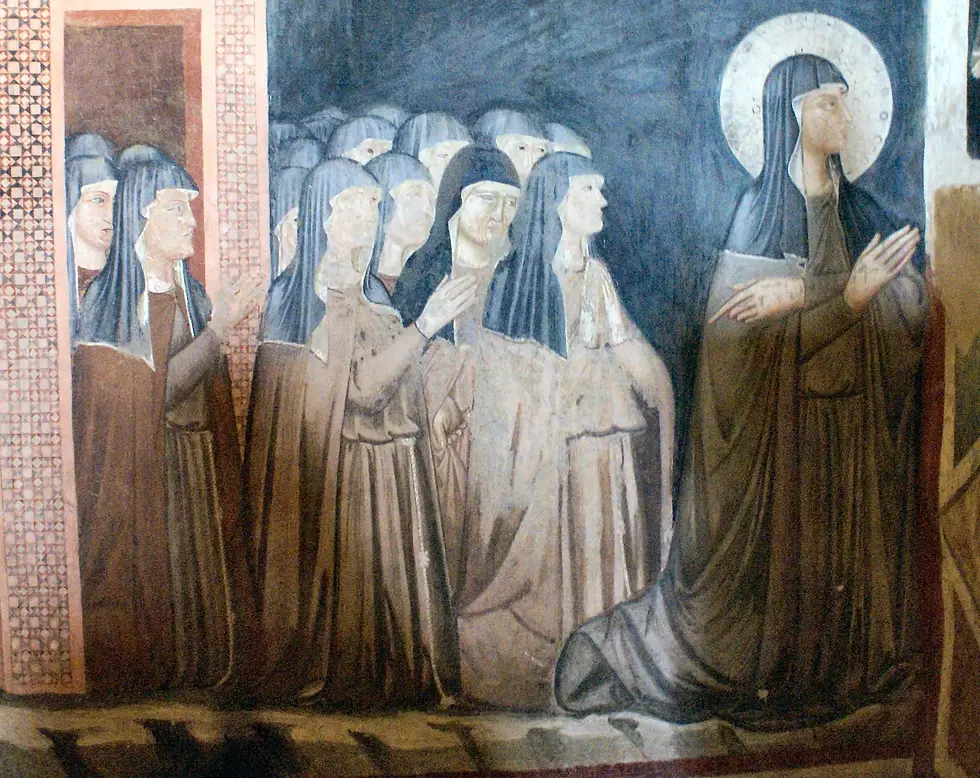
Divine Call to Reform: Visions of Saint Francis
In 1406, a pivotal vision: Saint Francis appeared, commanding Colette to restore primitive Rule—absolute poverty, barefoot, perpetual fast, strict enclosure.
Released from reclusion with confessor's permission (Henry de Baume, Franciscan), Colette—now taking the name Colette—sought papal approval.
She traveled barefoot to Nice, meeting antipope Benedict XIII (Avignon obedience).
Impressed by her holiness, he named her superior general of all Poor Clares willing to reform, granting privileges.
Colette returned to France, beginning arduous work amid Great Western Schism and Hundred Years' War chaos.
The Reform Movement: Trials and Triumphs Across Europe
Colette's reform faced fierce resistance: many convents enjoyed mitigations (possessions, meat, relaxed enclosure). Sisters and friars opposed her; some attempted violence.
Undaunted, Colette persevered with gentleness and miracles. She founded first reformed convent at Besançon (1410), then others: Auxonne, Poligny, Decize, Heidelberg, Amiens.
Traveling extensively—often barefoot—she reformed existing houses in France, Savoy, Flanders. By death, seventeen convents followed her Colettine observance.
Key supporters: Henry de Baume (confessor), Duchess Philippa of Burgundy, Countess of Geneva.
Miracles authenticated mission:
Raising the dead — Restored stillborn child to life for baptism (repeated thrice).
Multiplication of food — Small loaves fed multitudes.
Healing — Cured blindness, lameness, fever through touch or prayer.
Prophecy — Foretold events, read consciences.
Bilocation and ecstasy — Seen in multiple places; raptures during Mass.
Once, attackers struck her; wounds healed instantly.
Colette emphasized: "If there be a true way to follow Christ, it is the way of poverty."
Final Years in Ghent and Holy Death
In 1447, aged 66 and weakened, Colette settled in Ghent convent she founded. Foretelling death, she exhorted sisters to fidelity.
On March 6, 1447, she died peacefully, face radiant. Body remained incorrupt, flexible, fragrant—verified multiple examinations.
Translated several times (wars, revolutions); final shrine in Ghent monastery.
Beatified 1741, canonized 1807—miracles included curing blindness and paralysis.
Canonization and Colettine Legacy
Canonization confirmed reform's fruits: Colettine Poor Clares (Contemplative branch) spread worldwide, maintaining strict observance.
Today, hundreds of Colettine monasteries exist—Europe, Americas, Africa, Asia.
Ghent shrine attracts pilgrims; incorrupt body visible in glass reliquary.
Colette invoked for safe childbirth (from reviving infants), eye diseases, family troubles.
Images depict her in Poor Clare habit with crucifix, lily, or book of Rule; often with Saint Francis.
Spirituality: Primitive Poverty and Contemplative Zeal
Saint Colette's charism centers on:
Absolute poverty → Model for detachment.
Strict observance → Fidelity to founders' vision.
Mystical union → Ecstasies from Eucharistic devotion.
Reform through gentleness → Charity amid opposition.
She teaches renewal begins personal conversion, spreads through example.
Catholics honoring her can:
Practice voluntary poverty.
Deepen Eucharistic adoration.
Support contemplative orders.
Pray for Church reform.
Read her letters or vita.
Colette shows grace triumphs over resistance.
Daily Mass Readings for March 6, 2026 (Thursday of the Second Week of Lent)
Readings contrast worldly trust with divine blessing—themes Colette lived by renouncing comfort for poverty.
First Reading: Jeremiah 17:5-10
Cursed who trusts in human beings... Blessed who trusts in LORD... Heart deceitful... I, LORD, alone probe heart...
Responsorial Psalm: Psalm 1:1-4, 6
R. Blessed are they who hope in the Lord.
Blessed who delight in law of LORD... Like tree planted near streams... LORD watches over way of just...
Gospel Acclamation: Luke 8:15
Blessed who hear word of God and observe it.
Gospel: Luke 16:19-31
Rich man feasted sumptuously; Lazarus longed for scraps... Both died; Lazarus in Abraham's bosom, rich man tormented... "If they not listen Moses and prophets, neither convinced if someone rise..."
Reflection on the Readings in Light of Saint Colette
Readings warn against self-reliance, bless trust in God. Jeremiah curses human trust—Colette abandoned security for reclusion and reform, trusting divine visions.
Psalm celebrates delight in law—Colette restored primitive Rule with joy.
Gospel's rich man/Lazarus parable condemns indifference to poor. Colette lived opposite: embracing poverty, serving marginalized through convents' hospitality and prayer.
Rich man's torment from neglect echoes resistance Colette faced—yet she responded charity, winning hearts.
These texts with Colette's memorial challenge attachments: Do we trust wealth or God? Her life answers: blessed are poor in spirit, hoping in Lord.
Conclusion: A Reformer's Enduring Light
Saint Colette of Corbie proves Holy Spirit renews Church through humble instruments. From walled cell to Ghent shrine, from resisted reform to thriving Colettines, her life proclaims: faithful poverty and contemplative love bear eternal fruit.
On this March 6, may her intercession renew Franciscan fervor and detachment in us all.
Prayer to Saint Colette
O Saint Colette, valiant reformer and lover of poverty, you who restored Clare's primitive spirit amid trials, intercede for us. Teach us trust in God alone, delight in His law, compassion for poor. Obtain renewal for contemplative life, healing for afflicted. Through your prayers, may we bear fruit like trees by living water. Amen.


Comments