
Daily Saints: Saint Theodosius the Cenobiarch - January 11
- David EvansWood

- Feb 11
- 5 min read
Welcome to another installment of our Daily Saints series on SeaAndSeeds.com, where we explore the inspiring lives, virtues, and spiritual legacies of the holy men and women who illuminate our Catholic faith. Today, on January 11, we honor Saint Theodosius the Cenobiarch, a pioneering monk and founder of cenobitic (communal) monasticism in Palestine, whose life of asceticism, leadership, and miracles exemplifies the pursuit of holiness through community and prayer. Born in 5th-century Cappadocia and drawn to the Holy Land's desert solitude, Theodosius established vast monasteries that became beacons of Christian life amid the Byzantine Empire's theological debates and invasions. Known as "the Cenobiarch" (leader of common life), he balanced rigorous discipline with compassionate care for the poor, sick, and pilgrims, influencing Eastern monasticism profoundly. His feast day reminds us of the communal dimension of faith, the transformative power of repentance, and God's provision in adversity. In this comprehensive article, we will delve into the historical backdrop of late antique Christianity, his detailed biography, the miracles attributed to him, his pivotal role in monastic development, the evolution of his veneration and shrines, theological reflections on his sanctity, popular devotions, and his enduring message for contemporary Catholics. As we journey through his story, may we plant seeds of communal prayer and charity, navigating the seas of individualism with Theodosius as our guide.
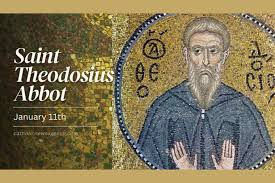
Historical Context: 5th and 6th-Century Byzantine Palestine – Monastic Boom, Theological Controversies, and Imperial Shifts
To appreciate Saint Theodosius the Cenobiarch's life and contributions, we must first contextualize him within the tumultuous yet spiritually fertile landscape of 5th and 6th-century Byzantine Palestine, a period marked by the consolidation of Christian doctrine, the rise of monasticism as a societal force, and the empire's struggles against internal divisions and external threats. This era, part of Late Antiquity, saw the Eastern Roman (Byzantine) Empire under emperors like Theodosius I (r. 379–395 AD), who made Christianity the state religion in 380 AD, and Justinian I (r. 527–565 AD), who codified laws and built architectural marvels like Hagia Sophia. Palestine, as the Holy Land, held sacred significance, attracting pilgrims, ascetics, and scholars, but it was also a frontier vulnerable to Persian invasions (e.g., 614 AD sack of Jerusalem) and later Arab conquests (634–638 AD).
Politically, the empire grappled with barbarian migrations in the West and Sassanid Persian rivalries in the East, while internally, administrative reforms divided provinces into themes for better defense. Palestine, under the Diocese of the East, was economically prosperous with agriculture, trade (via the Via Maris), and pilgrimage sites like Jerusalem's Church of the Holy Sepulchre (dedicated 335 AD). Socially, a mix of Greeks, Jews, Samaritans, and Arabs created cultural diversity, but tensions flared—Samaritan revolts (529 AD) and Jewish-Persian alliances during invasions.
Religiously, Christianity dominated post-Edict of Milan (313 AD), but theological controversies abounded. The Council of Chalcedon (451 AD) defined Christ's two natures, splitting the Church into Chalcedonians (Byzantine Orthodox) and Monophysites (who emphasized one nature, prevalent in Egypt and Syria). Theodosius, a staunch Chalcedonian, navigated these divides, supporting imperial orthodoxy against Monophysite leanings in Palestine. Monasticism exploded: inspired by Egyptian fathers like St. Anthony (251–356 AD), Palestinian deserts birthed lavras (semi-eremitic communities) and cenobia (fully communal). Figures like St. Euthymius (377–473 AD), Theodosius' mentor, and St. Sabas (439–532 AD) founded monasteries that served as spiritual, educational, and charitable centers.
Economically, monasteries like Theodosius' were self-sustaining, farming terraces and aiding the poor amid famines. Culturally, Greek was the liturgical language, but Aramaic/Syriac persisted. The era paralleled Old Testament communities, like Elijah's prophetic schools, fostering communal holiness. This context—doctrinal fervor, pilgrimage influx, imperial patronage—shaped Theodosius as a unifier, blending eremitic solitude with cenobitic structure.
The Life of Saint Theodosius the Cenobiarch: From Cappadocian Pilgrim to Palestinian Abbot
Saint Theodosius the Cenobiarch, born around 423 AD in Mogarissos, Cappadocia (modern Turkey), forged a legacy as the father of communal monasticism in Palestine through a life of pilgrimage, asceticism, and visionary leadership. Cappadocia, renowned for cave churches and saints like Basil the Great (329–379 AD), instilled early piety; young Theodosius served as a lector, chanting Scriptures, drawn to Abraham's call (Genesis 12:1).
At 20, he pilgrimaged to Jerusalem, visiting Sinai and meeting St. Simeon Stylites near Antioch, who prophesied his abbatial role. In Jerusalem, he joined Longinus' community at the Tower of David, but seeking solitude, entered St. Euthymius' lavra near Bethlehem around 451 AD. Euthymius, recognizing his communal gifts, redirected him to the Church of the Seat of Mary near Bethlehem, where Theodosius cared for elderly monks.
Around 465 AD, Theodosius founded his monastery in a cave at Cathismus (site of Mary's rest en route to Bethlehem), initially eremitic but evolving into a cenobium as disciples flocked. By 479 AD, it housed 400 monks in four churches: Greek, Armenian, Bessan (for possessed), and infirmary chapel. The complex included hospitals for sick/poor, hostels for pilgrims, workshops, and farms— a self-contained city embodying charity.
As cenobiarch, Theodosius enforced strict Rule: common property, obedience, manual labor, prayer. He preached against vices, emphasized Eucharist. During 492 AD famine, he miraculously fed multitudes. Amid Monophysite schism post-Chalcedon, he staunchly defended orthodoxy, debating Emperor Anastasius I's envoys in 516 AD, exiled briefly but recalled.
Aging, Theodosius predicted death, passing January 11, 529 AD, at 105. Buried in founding cave, his tomb drew pilgrims. Canonized by acclaim, feast January 11. Life echoes Acts 4:32: community of heart.
The Miracles of Saint Theodosius the Cenobiarch: Wonders of Provision and Healing
Saint Theodosius' sanctity manifested through miracles, affirming his union with God. From vitae by Theodore of Petra and Cyril of Scythopolis, these include provisions, healings, and prophecies.
During life: Multiplied bread/wine for 400 monks/guests; rain ended drought after prayer. Healed possessed in Bessan church; restored a blind man's sight. Prophesied events, like disciple's martyrdom.
Posthumous: Tomb healings—lame walked, sick cured. During 614 Persian invasion, monastery spared. Modern: Invoked for droughts, healings.
Theological: Miracles show communal faith's power (CCC 548).
Saint Theodosius the Cenobiarch's Role in the Church: Pioneer of Cenobitic Life
Theodosius pioneered cenobitism in Palestine, influencing Pachomius' Egyptian models. His monastery trained leaders, preserved orthodoxy.
In Eastern Church, model for lavra-cenobium balance; influenced Studite Rule.
Legacy: Patron of monks, invoked for unity. In global Church, inspires ecumenism.
The Shrines and Veneration of Saint Theodosius the Cenobiarch: From Desert Cave to Liturgical Honor
Veneration centers on Deir Dosi monastery ruins near Bethlehem, cave-tomb pilgrimage site. Founded 476 AD, restored post-Crusades.
Feast January 11: Divine Liturgy in Orthodox calendars, hymns praise cenobiarch.
Art: Icons depict cave, staff. Literature: Cyril's Life.
Veneration emphasizes community (CCC 946).
Theological Implications: Theodosius as Model of Communal Holiness and Orthodoxy
Theologically, embodies koinonia (Acts 2:42); Chalcedonian fidelity reflects Christology (CCC 467).
For monks: Balance solitude/community. Today, addresses isolation, promoting parish life.
Devotions to Saint Theodosius the Cenobiarch: Prayers for Unity and Provision
Devotions seek monastic virtues: Akathist hymn, "Rejoice, Cenobiarch..."
In monasteries: Vigils, relic veneration.
Modern: Ecumenical prayers.
Enduring Relevance: Saint Theodosius the Cenobiarch in Contemporary Catholic Life
In divided world, Theodosius' unity inspires dialogue; amid poverty, charity model.
For religious: Vocational perseverance. Modern miracles: Healings at shrine.
Enriching: Books on desert fathers. Global: Veneration in Orthodox lands. May Theodosius unite our hearts.


Comments